Hypnagogic hallucinations: the images at sleep's edge
A face at the edge of the room, your name called in an empty house, the floor dropping away — all as you drift off. Vivid, sometimes frightening, and usually completely normal.
8 min read · General wellness information, not a medical diagnosis · Auf Deutsch lesen →
The short answer
Hypnagogic hallucinations are vivid images, sounds or sensations that happen as you fall asleep — a face, a voice, a falling feeling, or a sense that someone is in the room. They are common and usually harmless, caused by the dreaming system switching on a moment before you fully lose consciousness. They become worth checking only if frequent and distressing, or paired with daytime sleep attacks.
You are on the edge of sleep when you see a face that is not there. Or you hear someone say your name, clearly, in an empty flat. Or the mattress seems to tip and you feel yourself falling, or you are suddenly certain there is a presence standing just beside the bed. It is vivid enough to snap you fully awake, heart going, and it can be genuinely unsettling. These are hypnagogic hallucinations — sensory experiences that arrive as you fall asleep. (The same thing on the way out of sleep has its own name, hypnopompic hallucinations.) For the vast majority of people they are a harmless quirk of a drowsy brain, not a symptom of anything wrong.
Why the brain creates hypnagogic hallucinations
Falling asleep is not a switch you flip; it is a fade, and for a brief window the fade overlaps two states. The boundary-state hallucinations get their own coverage in the Wikipedia article on hypnagogia. Waking awareness has not fully shut down, and the machinery that generates dreams has already begun to stir. In that overlap, dream-like fragments start bubbling up while you are still just conscious enough to notice them — and your half-in, half-out brain renders those fragments as real sights, sounds or sensations projected onto the actual room. That is the whole mechanism. It is not a vision, not a message, not your subconscious trying to tell you something. It is the dream projector warming up a few seconds before the lights are supposed to go down.
They come in every sense: geometric patterns, faces and figures (visual); your name, a doorbell, a snatch of music (auditory); a falling, floating or tilting sensation; or the pure, contentless feeling that someone is present.
Hypnagogic experiences cluster in the first minutes of sleep onset — the same border where hypnic jerks and, sometimes, sleep paralysis occur.
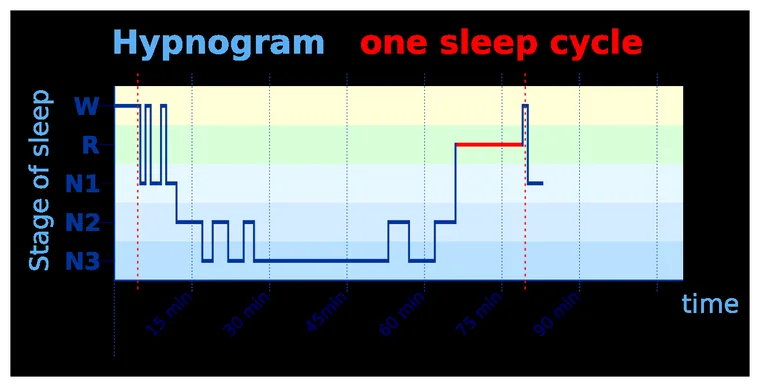
Zoom out to the whole night and the logic is clear: these events belong to the transition zones, not to the settled deep sleep in the troughs of the cycle. That is why they feel like they catch you "just as I was dropping off" — because that is precisely when the dreaming and waking systems overlap.
Across a full night, sleep cycles between light, deep and REM. Hypnagogic hallucinations belong to the wake-to-sleep transition at the start, not to the deep or REM stages themselves. Schlafgut · CC BY-SA 3.0 · Wikimedia Commons
What makes them more likely
Sleep deprivation and irregular schedules — an overtired, out-of-rhythm brain blurs the boundary between waking and dreaming.
Stress and anxiety, which keep the nervous system on alert as you try to drop off.
Alcohol and certain medications, which distort the normal architecture of sleep.
A link with sleep paralysis — when the drowsy hallucination arrives together with the temporary can't-move state of REM, you get the classic terrifying "figure in the room" of a sleep paralysis demon.
The same disrupted-sleep triggers behind most edge-of-sleep events. General pattern, not a clinical scale.
They feel like a message because they are so vivid. They are really just
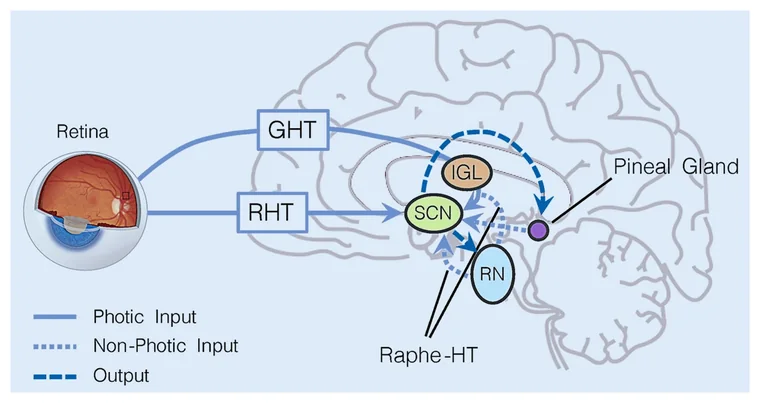
An out-of-sync body clock — from shifting schedules or poor light habits — blurs the wake-sleep boundary where these images appear. The circadian system shown here keeps that boundary crisp when it runs on time. Christine Blume, Corrado Garbazza & · CC BY 4.0 · Wikimedia Commons
When to see a doctor
Occasional hypnagogic hallucinations are normal and need no treatment. It is worth a conversation with a doctor if they are frequent and distressing, if they come alongside sudden daytime sleep attacks or episodes of muscle weakness triggered by strong emotion (a combination that can point to narcolepsy), or if you are seeing or hearing things while fully awake and alert during the day — that last one is a different situation entirely and deserves proper assessment rather than reassurance.
Sleep paralysis and its cousins share the stage
Hypnagogic hallucinations are not isolated; they belong to the boundary stage that also produces sleep paralysis and the vivid dream-like images at waking (the waking version). The shared mechanism is a brain that has not fully switched between wakefulness and sleep, so fragments of dreaming bleed into being awake. This is why the hallucinations are fleetingly real-feeling and why they can feel so alarming when a shadow or a voice appears "in" the bedroom.
Knowing the family helps in one practical way: the levers that quiet hypnagogic hallucinations are the levers that quiet all of them. Sleep consistently and enough, because fatigue widens the boundary phase. Keep alcohol and stimulants modest in the evening. And when one happens, remind yourself it is a stage-transition event with a known mechanism — the fear is the part you add after the fact, and it is the part you can decline. The reassurance question and when to actually worry are covered alongside in the sleep paralysis guide.
Where SleepTrace fits
These experiences ride on tired, ragged, irregular sleep — the exact thing you cannot judge from the inside. SleepTrace maps your nights from your iPhone and trends them, so you can see whether your episodes track with short or broken sleep, and watch them ease as your sleep becomes more regular. Understanding that they are a normal edge-of-sleep event, and seeing your sleep steady on a chart, takes most of the fear out of them.
Frequently asked questions
Yes — experiencing vivid images, sounds or sensations as you fall asleep is common and, on its own, harmless. It reflects the dreaming system switching on just before you lose consciousness. They become worth checking only if frequent and distressing or paired with daytime sleep attacks.
Hypnagogic hallucinations happen as you fall asleep; hypnopompic hallucinations happen as you wake up. The mechanism is similar — an overlap between dreaming and waking awareness — and both are usually benign.
References
Drugli EH, Lehmann OE, Pallesen S, Saxvig IW, et al. Prevalence of different parasomnias in the general Norwegian population. Front Sleep (2026). Europe PMC
SleepTrace is a wellness app, not a medical device. This article is general information, not medical advice. If your symptoms are frequent, severe or worrying, please talk to a doctor.
Hear your own night. SleepTrace turns a night of audio into your sleep phases, the sounds you made, and how it all trends — no wearable, just the iPhone on your nightstand. Download on the App Store →