Exploding head syndrome: the loud bang that isn't real
A gunshot, a crash, a bang — loud enough to jolt you upright, but there is no sound and no pain. It has an alarming name and a reassuringly boring explanation.
8 min read · General wellness information, not a medical diagnosis · Auf Deutsch lesen →
The short answer
Exploding head syndrome is a harmless parasomnia: as you drift into or out of sleep, your brain briefly misfires in the auditory pathway and you 'hear' a loud bang, crash or zap that never actually happened. It is painless, does no damage, and is worsened mainly by stress and sleep deprivation — so knowing it is benign is itself the most effective treatment.
The name is doing an enormous amount of work here, most of it unfair. Exploding head syndrome sounds like something from a horror film; what it actually describes is harmless. As you drift down into sleep, or float back up out of it, you suddenly "hear" a loud noise that is not happening in the room — a bang, a crash, a gunshot, an electrical zap, a cymbal. There is a jolt of fear, sometimes a flash of light or a jerk of the body, and then… nothing. No pain. No aftermath. Just a spectacularly convincing false alarm your own brain set off.
People often keep it to themselves for years, half-worried it means a stroke or a tumour or that they are losing their grip. So the single most useful thing to say up front is this: it is recognised, it is common, and it is benign.
What exploding head syndrome actually is
It sits in the family of parasomnias — odd events that happen at the fuzzy border between wake and sleep. The recognised diagnosis sits here, described in the Wikipedia article on exploding head syndrome. The leading explanation is a hiccup in the way your brain powers itself down. Normally, as you fall asleep, the brain dims its motor and sensory systems in an orderly sequence, like a building shutting off lights floor by floor. The theory is that in exploding head syndrome a small cluster of neurons in the hearing pathway briefly misfires during that handover — a short, uncoordinated burst of activity that your brain, still listening, interprets as a very loud sound. It is a glitch in the shutdown routine, not a sign that anything is wrong inside your head.
Episodes strike during the transition into or out of sleep — the same drowsy border where a hypnic jerk or a hypnagogic image can appear. They do not happen in settled deep sleep.
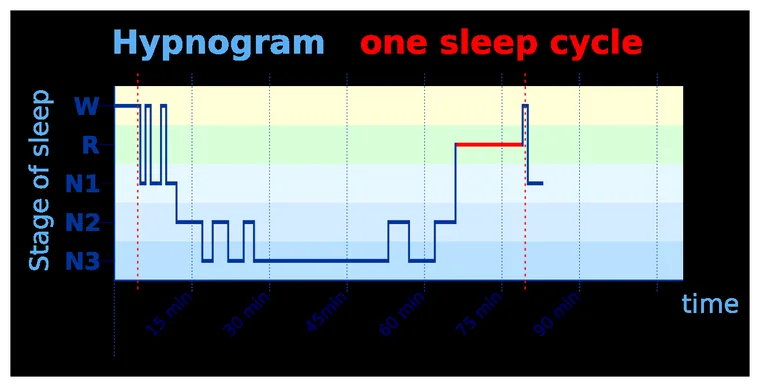
To see why the timing matters, it helps to picture a normal night. Sleep is not a flat state — it is a cycle through light sleep, deep sleep and REM, repeated several times, with brief surfacings near the boundaries. Exploding head syndrome lives at those boundaries, which is exactly why it feels like it catches you "just as you were dropping off".
A normal night cycles through light, deep and REM sleep. Edge-of-sleep events like exploding head syndrome occur at the transitions, not in the deep troughs. Schlafgut · CC BY-SA 3.0 · Wikimedia Commons
Who gets it, and what makes it worse
It is far more common than its obscurity suggests — surveys of the general population find that a meaningful slice of people have experienced at least one episode, and contrary to the old assumption, it is not limited to older adults; plenty of students and young adults report it. The reliable triggers are the same unglamorous suspects behind most sleep oddities:
Stress and anxiety — comfortably the biggest amplifier.
Sleep deprivation and irregular schedules — a ragged sleep-wake cycle makes the nightly handover into sleep less smooth.
Fatigue and burnout — episodes tend to cluster in rough patches and melt away once sleep steadies.
The pattern points squarely at stress and disrupted sleep. General guide, not a clinical ranking.
For most people that is the entire story, and the most helpful intervention is simply understanding it. Because the fear feeds the frequency — you brace for it, sleep worse, and give it more chances — the reassurance itself often quiets it down. People who learn what it is frequently report the episodes fading within weeks.
The bang is real to your brain and fake to the world. Once you know which is which,
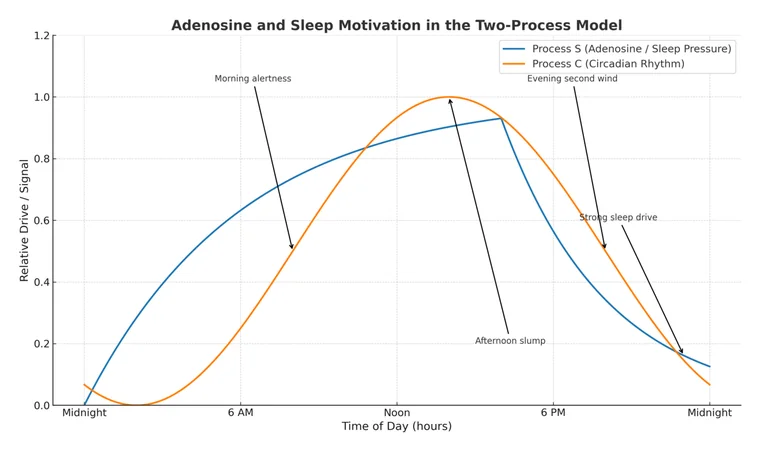
Sleep is governed by rising sleep pressure and the body clock. An irregular, sleep-deprived schedule leaves both out of sync — the state that makes the nightly handover into sleep, and episodes like this, more likely. Rocxie · CC BY-SA 4.0 · Wikimedia Commons
When to see a doctor
Exploding head syndrome is painless by definition — that is the diagnostic line in the sand. If there is actual head pain with the noise, that is a headache disorder, not this, and it is worth getting checked. Also see a doctor if the episodes are frequent enough to wreck your sleep or make you dread going to bed, if they come with other neurological symptoms, or if the anxiety around them has grown into a problem of its own. Otherwise, better sleep habits and lower stress are essentially the whole prescription.
Where SleepTrace fits
Because episodes strike at the edge of sleep, they tend to ride along with nights that are short, broken and stressed. SleepTrace maps your nights from your iPhone's audio and trends them over time, so you can see whether your episodes line up with fragmented, irregular sleep — and watch them settle as your sleep steadies. It will not record the imaginary bang, because there is no real sound to record, but it shows you the state of the nights the bangs happen in.
Frequently asked questions
No. Despite the frightening name, it is painless and harmless — there is no evidence it damages the brain. The main harm is the anxiety and disrupted sleep it can cause. If there is actual head pain, that is a different problem and worth seeing a doctor about.
Stress, anxiety, sleep deprivation and irregular sleep schedules are the most consistent triggers. Episodes tend to cluster during difficult, tiring periods and ease off as sleep becomes more regular and restful.
References
Drugli EH, Lehmann OE, Pallesen S, Saxvig IW, et al. Prevalence of different parasomnias in the general Norwegian population. Front Sleep (2026). Europe PMC
SleepTrace is a wellness app, not a medical device. This article is general information, not medical advice. If your symptoms are frequent, severe or worrying, please talk to a doctor.
Hear your own night. SleepTrace turns a night of audio into your sleep phases, the sounds you made, and how it all trends — no wearable, just the iPhone on your nightstand. Download on the App Store →